
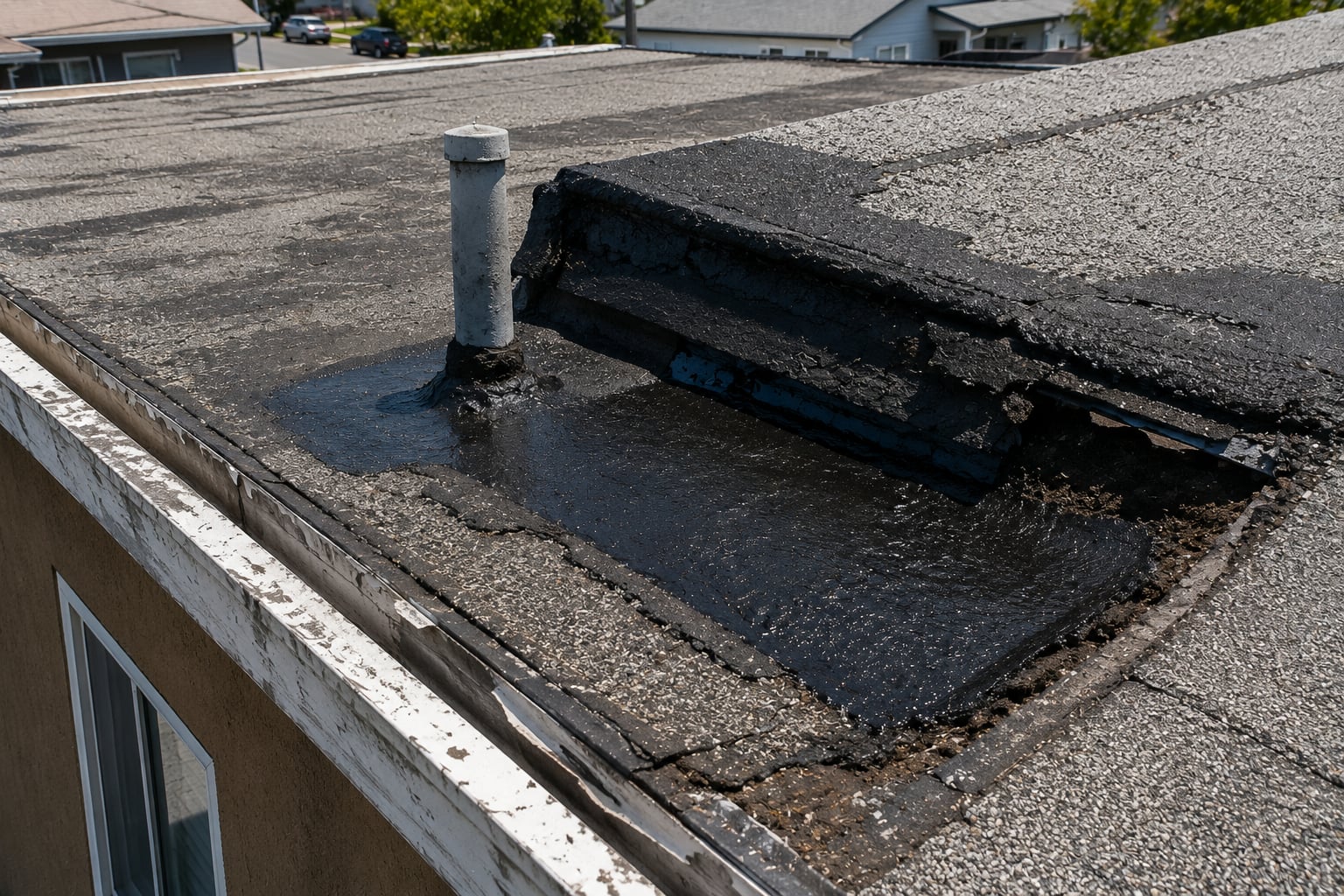
Ask most homeowners what kind of roof they have, and they will say shingle, tile, or flat. Older homes and small commercial buildings around Huntington Beach sometimes have something a little different underneath the surface: built up roofing, often called BUR, or the older term tar and gravel. It was one of the most common low slope roofing systems installed through the mid 1900s, and plenty of it is still up there quietly doing its job, patched and repatched over the decades.
What Built-Up Roofing Actually Is
Built up roofing gets its name from how it is constructed: alternating layers of asphalt and reinforcing felt, built up one on top of the other, usually three to five plies depending on the original installation. The whole assembly is typically finished with a layer of gravel or mineral cap, which protects the asphalt underneath from direct UV exposure and gives the roof its rough, stone covered appearance. If your low slope roof looks like tar and stone rather than a single smooth sheet, there is a good chance you are looking at BUR.
Why So Many Older HB Properties Still Have It
BUR was the standard low slope roofing choice for decades before single ply membranes like TPO and EPDM became common. A lot of older Huntington Beach homes with a flat or low slope section, along with older small commercial and multi-family buildings, were originally roofed this way and never fully converted to a newer system. As long as the roof keeps performing and repairs stay manageable, there is often no pressing reason to replace a functioning BUR roof with something newer.

How BUR Repair Actually Works
Repairing a BUR roof usually starts by pulling back the gravel cap around the damaged area to expose the felt layers underneath. Torn or blistered sections get cut out, and new felt plies are set in hot or cold applied asphalt to match the original build up, then resealed and recovered with matching gravel. It is a hands on process that rewards experience, since matching the existing layers correctly is what keeps a patch from becoming its own future leak point.
Common Problems We See on BUR Roofs
- Ponding water in low spots that never fully drains between rains.
- Blistering, where trapped moisture pushes up between the asphalt layers.
- Bare patches where the protective gravel cap has worn thin or washed away.
- Cracking and splitting at seams and around roof penetrations like vents and drains.
- Failed flashing where the roof meets a wall, chimney, or parapet.

BUR vs Modern Single-Ply Membranes
| Factor | Built-Up Roofing (BUR) | Single-Ply Membrane (TPO/EPDM) |
|---|---|---|
| Typical lifespan | 20 to 30 years | 20 to 25 years |
| Surface appearance | Gravel or mineral cap | Smooth continuous sheet |
| Repair approach | Cut out and rebuild layers | Patch or heat weld membrane |
| Weight | Heavier due to gravel cap | Lighter, single layer |
If a BUR roof is nearing the end of its life, it is worth having a conversation about whether to rebuild it as BUR again or convert to a modern flat roof membrane system instead. Both are legitimate low slope options, and the right call usually comes down to the roof's condition, budget, and how much longer the building is expected to need that roof.
Common Mistakes Property Owners Make
- Ignoring small ponding areas that look harmless but are steadily breaking down the layers underneath.
- Hiring a contractor without BUR specific experience, since the repair technique is genuinely different from membrane roofing.
- Walking on gravel surfaced areas more than necessary, which displaces the protective cap.
- Assuming an old roof automatically needs full replacement instead of getting an inspection first.

Preventive Maintenance Tips for BUR Roofs
- Have drains and scuppers cleared regularly so water actually leaves the roof instead of pooling.
- Schedule a walk through inspection once a year, and again after any significant storm.
- Address bare or thinning gravel patches before the asphalt underneath takes direct sun exposure.
- Keep a record of prior repairs so future work can be matched to the existing roof layers correctly.

When to Call a Professional
A single blistered area, a small bare patch, or minor ponding is usually a straightforward roof leak repair for a contractor familiar with BUR. Active leaking in multiple spots, extensive gravel loss, or a roof that has needed frequent patching in different areas over the past couple of years are stronger signs it is time for a full professional inspection to weigh repair against replacement. If a storm just moved through and you have an active leak, our emergency roof repair team can stabilize things the same day, and if water is overflowing at the roofline it is worth having your gutters and drains checked at the same time.
Frequently Asked Questions
What is built-up roofing (BUR)? +
Built-up roofing is a low-slope roof system made of alternating layers of asphalt and reinforcing felt, usually finished with a gravel or mineral cap. It was one of the most common commercial and low-slope residential roofing systems installed in the mid-1900s.
How do I know if my roof is BUR and not a single-ply membrane? +
A BUR roof typically has a gravel or mineral surfaced top layer rather than a smooth rubber or plastic sheet. If your low-slope roof looks like tar and stone rather than a single continuous membrane, it is very likely built-up roofing.
How long does built-up roofing typically last? +
A well maintained BUR roof commonly lasts 20 to 30 years. Many BUR roofs on older Huntington Beach homes and small commercial buildings are already at or past that range and are being kept going through targeted repairs.
Can a BUR roof be repaired instead of fully replaced? +
In most cases yes, especially if the damage is limited to a specific area like ponding water, a torn section, or a failed penetration. Widespread cracking or multiple active leaks across the roof are stronger signs that replacement is the more practical choice.
Why does my BUR roof have standing water after it rains? +
Ponding water usually points to a low spot in the roof deck or a drainage system that has degraded over time. Standing water that sits for more than 48 hours accelerates deterioration of the asphalt layers underneath and should be addressed rather than left alone.
Is it normal for gravel to wash off a BUR roof over time? +
Some gravel loss is normal over the life of a BUR roof, but bare patches exposing the asphalt underneath are a warning sign, since that surfacing protects the layers below from direct UV exposure.
Does insurance typically cover BUR roof repair? +
It depends on the cause. Storm or wind related damage is often covered, while gradual wear from age typically is not. A written inspection report documenting the specific cause of damage is usually needed either way.
Should I repair or replace an aging BUR roof? +
If the roof is showing isolated damage and is still within a reasonable age range, repair is usually the more cost effective choice. A roof nearing or past 25 to 30 years with recurring leaks in different spots is a stronger candidate for full replacement.
Built-up roofing has stood the test of time on plenty of Huntington Beach properties, and there is no reason to rush a replacement on one that is still performing. Keep drains clear, watch for bare patches and ponding, and get an inspection whenever something looks off rather than waiting for it to turn into an active leak.