
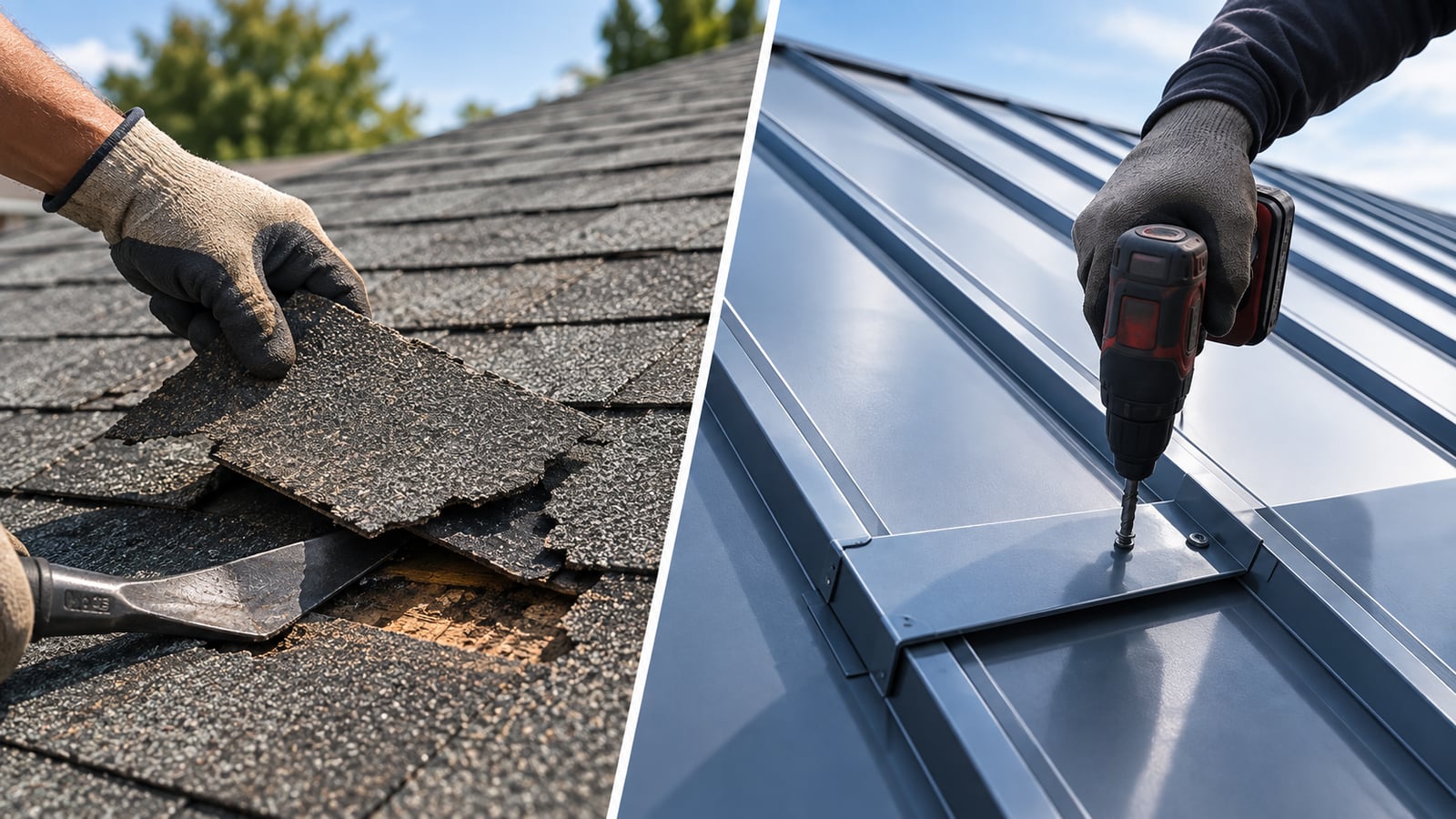
More homeowners in Huntington Beach are asking about metal roofing, usually after hearing about its long lifespan or seeing it on a newer build nearby. If you already have a metal roof, or you are comparing it against asphalt shingles for a future project, it helps to understand that metal is not just a different material bolted on the same way shingles are. The way it fails, the way it gets inspected, and the way it gets repaired are genuinely different, and a contractor who is excellent with shingles is not automatically equipped to work on metal.
Why Metal Roofing Behaves So Differently Than Shingles
Asphalt shingles are individual overlapping pieces, so damage is usually isolated to a handful of shingles that can be pulled and replaced on their own. Metal roofing is typically installed as long continuous panels or interlocking sheets, which means the roof behaves more like a single connected system. A problem at one seam or fastener can affect how water moves across a much larger section, and a repair often has to account for how the whole panel run performs rather than just the damaged spot.
The Repair Techniques Themselves Are Different
Shingle repair mostly comes down to removing and replacing damaged pieces with matching material and fresh sealant at the nail heads. Metal roof repair uses a different toolkit entirely. Fasteners are torqued to a specific tension so they seal properly without overdriving and deforming the panel. Seams get resealed with butyl tape or specialty sealants rated for metal expansion and contraction, not standard roofing cement. Panel sections that are truly damaged, rather than just loose, sometimes need to be cut out and replaced with a matched profile, which requires sourcing the right gauge and finish to blend with the surrounding roof. If you're weighing metal against shingles for a full replacement rather than a repair, our guide on standing seam metal roof cost breaks down what that upfront investment actually looks like.
Common Metal Roof Problems We See
- Fasteners that have backed out or loosened from years of thermal expansion and contraction.
- Sealant at seams and penetrations that has dried out, cracked, or lost adhesion.
- Surface rust developing where the protective coating has worn through or been scratched.
- Oil canning, the wavy rippled look that shows up on flat panel sections.
- Flashing around chimneys, vents, and skylights pulling away or corroding.

Metal Roof Repair vs Shingle Repair at a Glance
| Factor | Asphalt Shingle | Metal Roofing |
|---|---|---|
| Typical lifespan | 20 to 30 years | 40 to 70 years |
| Common repair type | Replace individual shingles | Reseal seams, retighten or replace fasteners |
| Repair skill needed | Widely available among roofers | Requires metal specific experience |
| Main failure point | Granule loss, curling, cracking | Sealant, fasteners, flashing |
The most common repair difference we run into is around standing seam panels specifically, since the raised seams that make this style so weathertight also require particular clips and sealants to repair correctly. Get it wrong and a repair can look fine for a season before the seam starts working loose again.

Common Mistakes Homeowners Make
- Hiring a shingle focused roofer for a metal repair without confirming metal specific experience first.
- Using standard roofing cement on metal seams instead of sealant actually rated for metal expansion.
- Assuming surface rust always means the whole roof needs replacing, when it is often treatable.
- Ignoring a small popped fastener, which lets water in and worsens the surrounding sealant over time.
Preventive Maintenance Tips for Metal Roofs
- Have fasteners checked annually, since they are the most common source of small leaks over time.
- Keep an eye on chimney, vent, and skylight flashing, which ages faster than the panels themselves.
- Address surface rust as soon as it appears rather than waiting for it to spread.
- Clear debris and standing water near valleys and low slope sections to protect seams and coatings.

When to Call a Professional
A single loose fastener or a small area of failed sealant is usually a straightforward repair for a contractor experienced with metal roofing. Active leaking, spreading rust, or damage across multiple panels is a stronger sign you need a full professional inspection before deciding between a targeted roof leak repair and a larger replacement. If a storm has just come through and you are dealing with an active leak, do not wait on it. Our emergency roof repair team can stabilize the situation the same day, and if the metal roofing sends water into the gutters faster than usual after a repair, it is worth having your gutters checked at the same time.
For comparison, this is what a shingle roof repair looks like up close, the kind of individual shingle replacement that simply does not apply to a metal roof system.

Frequently Asked Questions
Is metal roof repair more expensive than shingle repair? +
It depends on the problem. A small fastener or sealant repair on a metal roof is often comparable in cost to a shingle patch. Panel replacement or seam work tends to run higher than shingle repair because it usually requires a specialist familiar with the specific panel profile.
Can any roofer repair a metal roof? +
Not every roofing contractor works on metal regularly. Metal roofing uses different fasteners, sealants, and installation techniques than shingles, so it is worth confirming a contractor has specific metal roofing experience before hiring them for the job.
How long does a metal roof last compared to asphalt shingles? +
A well maintained metal roof commonly lasts 40 to 70 years, compared to 20 to 30 years for asphalt shingles. Metal's longer lifespan is one of its biggest advantages, though the higher upfront installation cost is the tradeoff.
What causes most metal roof leaks? +
Most metal roof leaks trace back to failed sealant at seams and penetrations, loosened or backed out fasteners, or damaged flashing around chimneys and vents, rather than the metal panels themselves failing.
Is rust a sign my metal roof needs to be replaced? +
Not necessarily. Surface rust on a coated panel can often be treated and repainted. Rust that has eaten through the panel material or spread across large sections is a stronger sign that repair alone will not solve the underlying problem.
Does oil canning mean my metal roof is defective? +
Oil canning, the wavy or rippled look on flat panel sections, is usually a cosmetic result of the metal expanding and contracting rather than a structural defect. It is common on flat panel profiles and rarely affects how well the roof performs.
Can you match the paint color on an older metal roof repair? +
In most cases yes, though older factory finishes fade over years of sun exposure, so a brand new panel or fresh coating may look slightly different than surrounding weathered panels until it weathers in as well.
How often should a metal roof be inspected? +
Once a year is a reasonable baseline for most metal roofs, with an added check after any major windstorm, since loosened fasteners and lifted panel edges are the kind of small issues that are easy to catch early and expensive to ignore.
Metal and shingle roofs both do their job well when they are maintained by someone who understands how that specific material actually fails. If your roof is metal, the biggest thing you can do is make sure whoever inspects or repairs it has real experience with metal specifically, not just a willingness to give it a try.